Clinical Scenario:
A 4-month-old infant is brought with poor weight gain, recurrent chest infections and increasing respiratory difficulty. On examination, he is tachypneic with mild central cyanosis. There is a hyperdynamic precordium and a right ventricular heave. The second heart sound is widely split with a loud pulmonary component, and there is a grade 2/6 systolic ejection murmur at the left upper sternal border.
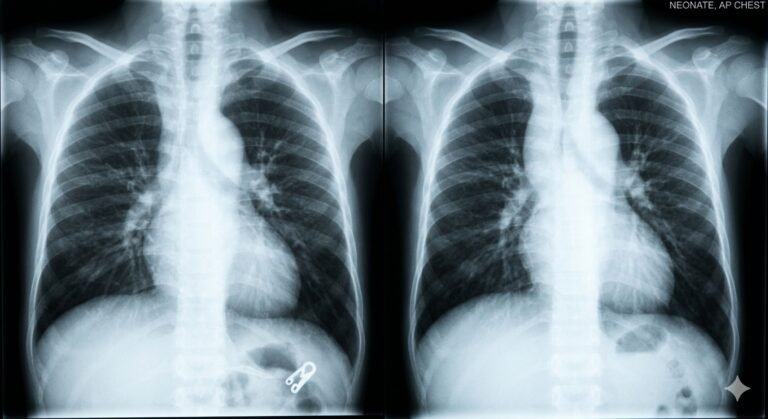
Chest radiograph shows cardiomegaly with increased pulmonary vascular markings and a prominent upper mediastinal shadow.
Which of the following is the most likely diagnosis?
A. Atrial septal defect
B. Tetralogy of Fallot
C. Total anomalous pulmonary venous return
D. Transposition of the great arteries
E. Truncus arteriosus
Correct answer & Explanation:
Explanation
Correct answer: C. total anomalous pulmonary venous return.
TAPVR is a cyanotic congenital heart defect in which all pulmonary venous blood returns to the systemic venous circulation rather than directly to the left atrium. An atrial-level communication is therefore essential for systemic blood flow.
This child has features of unobstructed TAPVR:
- Mild central cyanosis
- Poor weight gain and recurrent respiratory symptoms
- Hyperdynamic precordium/right ventricular heave
- Widely split S2 with a loud pulmonary component
- Systolic ejection murmur due to increased pulmonary blood flow
- Cardiomegaly and pulmonary plethora on chest radiograph
The particularly important radiological clue is the snowman or figure-of-eight appearance. In supracardiac TAPVR, the dilated anomalous venous pathway forms the upper part of the snowman, while the enlarged cardiac silhouette forms the lower part.
The snowman sign is usually a late-developing finding and is uncommon in young infants, which is why using an older infant/child with unobstructed supracardiac TAPVR makes the scenario more authentic.
Why the other options are less likely
- Atrial septal defect: can produce a widely split S2 and pulmonary plethora, but significant cyanosis and the characteristic snowman appearance favor TAPVR.
- Tetralogy of Fallot: usually produces a boot-shaped heart and reduced pulmonary vascularity, particularly with significant pulmonary stenosis.
- Transposition of the great arteries: typically presents with more prominent cyanosis early in life.
- Truncus arteriosus: usually presents earlier with heart failure and pulmonary overcirculation, but does not produce the characteristic snowman appearance.
Differential Diagnosis Tip:
When managing a critically ill infant with cyanosis or shock, you must systematically rule out other left-sided obstructive and duct-dependent lesions. To master these crucial exam distinctions, test your diagnostic reasoning with our comprehensive guide on Neonatal Presentation of Congenital Heart Disease.
Reference
- Merck Manual Professional Edition. Total Anomalous Pulmonary Venous Return (TAPVR).
- Ferguson EC, Krishnamurthy R, Oldham SAA. Classic Imaging Signs of Congenital Cardiovascular Abnormalities. RadioGraphics. 2007;27(5):1323–1334
- Weaver MD, Chen JTT, Anderson PAW, Lester RG. Total anomalous pulmonary venous connection to the left vertical vein: a plain-film sign useful in early diagnosis. Radiology. 1976;118(3):679–683.
💡 Clinical Concept Note:
- The “Snowman Sign” (figure-of-8 heart) does NOT show up in neonates. It takes a few weeks to months to develop as the supracardiac veins dilate over time.
- In a neonate (especially with obstructed TAPVR), the X-ray typically reveals a normal-sized heart with severe, diffuse pulmonary venous congestion and edema (ground-glass appearance)
- The “Snowman Sign” (figure-of-8 heart) does NOT show up in neonates. It takes a few weeks to months to develop as the supracardiac veins dilate over time.