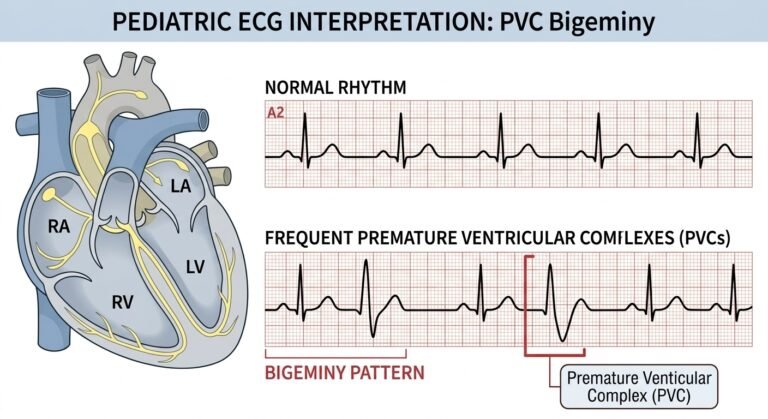
Clinical Scenario:
A 12-year-old boy is referred to the pediatric cardiology clinic after an irregular heartbeat is noted during a school health examination. He is otherwise asymptomatic and has no history of syncope, chest pain or exercise intolerance. His physical examination is normal.
A 24-hour Holter monitor shows frequent premature ventricular complexes (PVCs), accounting for 18% of all ventricular beats. The PVCs have a single morphology and disappear during exercise. Echocardiography shows a structurally normal heart with normal left ventricular systolic function.
What is the most appropriate management?
A. Reassurance and follow-up
B. Start amiodarone
C. Start propranolol
D. Electrophysiological study
E. Implantable cardioverter-defibrillator
Correct answer Explanation:
Correct answer: A. Reassurance and follow-up
Explanation
In children with a structurally normal heart, isolated monomorphic PVCs are usually benign, particularly when they suppress with exercise and the child has no concerning symptoms.
However, this child has a relatively high PVC burden (18%). Frequent PVCs warrant assessment for ventricular function and periodic follow-up because a high PVC burden can occasionally be associated with PVC-induced cardiomyopathy.
The important reassuring features are:
- Single (monomorphic) PVC morphology
- No syncope or other concerning symptoms
- Structurally normal heart
- Normal ventricular systolic function
- PVCs suppress with exercise
Therefore, immediate antiarrhythmic treatment or invasive electrophysiological intervention is not routinely indicated. Management is generally observation with periodic clinical assessment, ECG/Holter monitoring and echocardiographic evaluation of ventricular function.
When would PVCs be more concerning?
PVCs deserve greater attention when they are:
- Polymorphic
- Increasing with exercise
- Associated with syncope or exertional symptoms
- Occurring in couplets or runs of nonsustained ventricular tachycardia
- Associated with structural heart disease or ventricular dysfunction
- Associated with a concerning family history of sudden cardiac death
Exam pearl:
In an asymptomatic child with a structurally normal heart, monomorphic PVCs that suppress with exercise are generally benign, but frequent PVCs require follow-up for possible ventricular dysfunction.
Reference
Crosson JE, Callans DJ, Bradley DJ, et al. PACES/HRS expert consensus statement on the evaluation and management of ventricular arrhythmias in the child with a structurally normal heart. Heart Rhythm. 2014;11(9):e55–78.