Clinical Scenario:
A 2-year-old boy is brought to the emergency department with a generalized tonic-clonic seizure that has been ongoing for 8 minutes. He has no IV access, and attempts by the nursing staff have failed twice. He has a temperature of 39.2°C and no history of prior seizures.
What is the most appropriate immediate step in management?
A. Continue attempting IV access before giving any anticonvulsant
B. Give buccal or intranasal midazolam
C. Give IV phenytoin once access is secured
D. Give rectal paracetamol only and observe
E. Proceed directly to rapid sequence intubation
Correct Answer & Explanation:
Correct answer: B
Explanation: Status Epilepticus Treatment
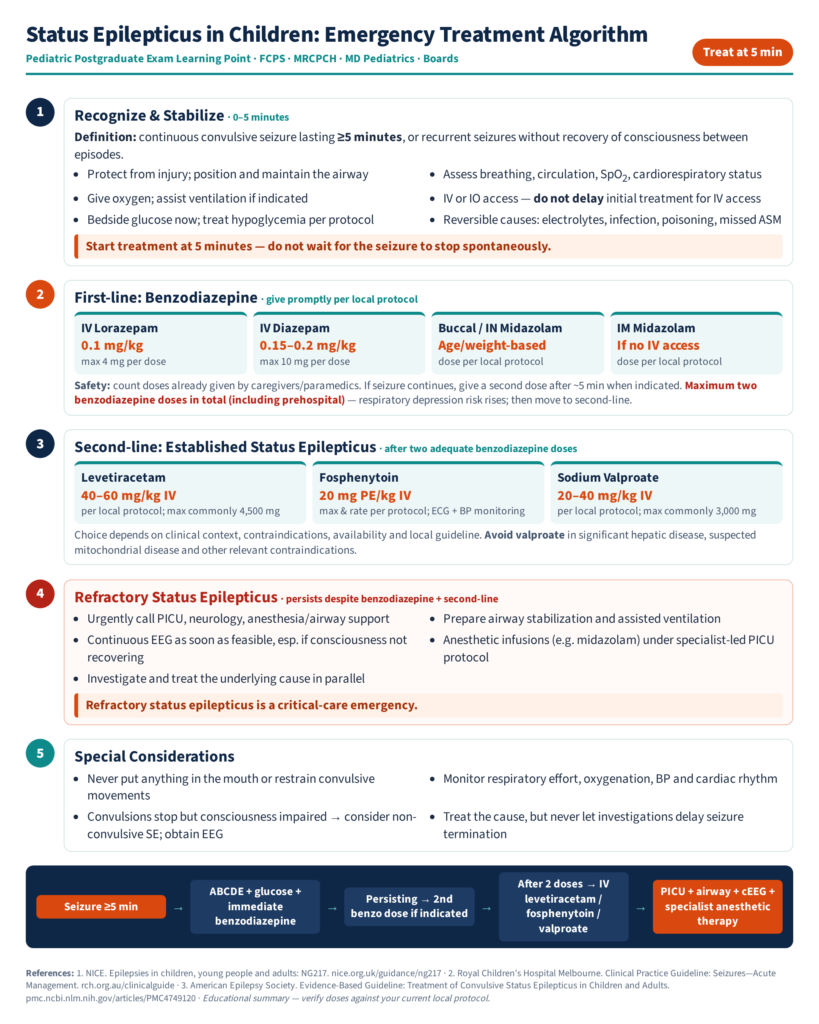
This child is in early status epilepticus (seizure activity >5 minutes, by definition — a seizure lasting longer than a typical self-limiting seizure and requiring treatment). When IV access is not readily available, first-line therapy should not be delayed — the non-IV route of benzodiazepine (buccal midazolam, intranasal midazolam, intramuscular midazolam, or rectal diazepam) should be given immediately.
Key principles:
- Definition of status epilepticus: continuous seizure ≥5 minutes, or recurrent seizures without recovery of consciousness in between.
- Time is critical — prolonged seizures cause increasing neuronal injury and become progressively harder to terminate the longer they continue.
- If IV access is unavailable, do not delay status epilepticus treatment trying to secure it — use buccal/intranasal/IM midazolam or rectal diazepam as first-line.
- Only once IV access is achieved should IV benzodiazepines and subsequent second-line agents (phenytoin/fosphenytoin, levetiracetam, valproate) be used.
Why the other options are wrong:
- A — treatment should never be delayed for IV access; non-IV benzodiazepines are just as effective as first-line therapy.
- C — phenytoin is a second-line agent, given only after benzodiazepine failure, and requires IV access which is not yet available.
- D — while fever should be addressed, antipyretics do not treat ongoing seizure activity; this child needs an anticonvulsant now, not just fever control.
- E — intubation/anesthesia is reserved for refractory status epilepticus (failure of first- and second-line agents), which hasn’t yet been attempted here.
Find high yield Board review MCQs on Pediatric Neurology.
References
- Trinka E, Cock H, Hesdorffer D, Rossetti AO, Scheffer IE, Shinnar S, et al. A definition and classification of status epilepticus—Report of the ILAE Task Force on Classification of Status Epilepticus. Epilepsia. 2015;56(10):1515-1523. View via ILAE
- National Institute for Health and Care Excellence. Epilepsies in children, young people and adults: diagnosis and management.
You can practice another MCQ on fever with altered sensorium.