Clinical Scenario:
A 6-year-old boy with a known ventricular septal defect is asymptomatic and has normal growth. On examination, there is a harsh pansystolic murmur at the left lower sternal border. A new high-pitched early diastolic murmur is also heard along the left sternal border. Echocardiography shows a supracristal (outlet) VSD with prolapse of the right coronary cusp of the aortic valve.
Which of the following is the most likely complication?
A. Aortic regurgitation
B. Complete heart block
C. Infective endocarditis
D. Pulmonary hypertension
E. Right ventricular outflow obstruction
Correct answer & Explanation
Correct answer: A. Aortic regurgitation
Explanation
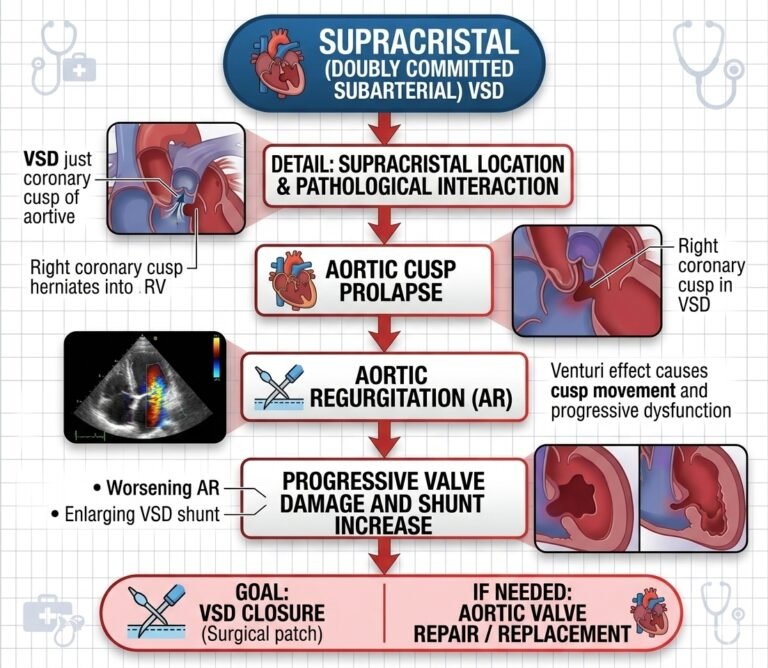
The most likely complication is aortic regurgitation (aortic insufficiency) caused by prolapse of the right coronary cusp into the supracristal VSD.
The key clue is the combination of a supracristal (outlet) VSD and prolapse of the right coronary cusp of the aortic valve. Supracristal VSDs are located immediately beneath the aortic valve and lack the normal muscular support provided by the conal septum. As a result, the aortic cusp—particularly the right coronary cusp—can progressively prolapse through the defect.
Once the cusp prolapses, it may become distorted and fail to coapt properly with the other aortic cusps during diastole. This produces aortic regurgitation, which clinically produces the new high-pitched early diastolic murmur along the left sternal border.
The important sequence is:
Supracristal VSD → aortic cusp prolapse → failure of aortic cusp coaptation → aortic regurgitation
The new diastolic murmur is therefore an important clinical clue that the VSD has developed an aortic valve complication, even though the child remains asymptomatic and has normal growth. Outlet VSDs with aortic cusp prolapse can develop progressive aortic insufficiency and may require closure to prevent further deterioration of the aortic valve.
Why the other options are wrong
B. Complete heart block
Complete heart block is more strongly associated with defects or interventions involving the conduction system near a perimembranous VSD, particularly after surgical or device closure. It is not the characteristic complication of a supracristal VSD with right coronary cusp prolapse.
The presence of aortic cusp prolapse and a new early diastolic murmur points directly toward aortic valve dysfunction rather than conduction disease.
C. Infective endocarditis
An unrepaired VSD can increase the risk of infective endocarditis, so this is a possible complication of VSDs in general. However, there is no evidence of fever, systemic illness, a new regurgitant murmur from infection, or vegetations in this case.
More importantly, the echocardiographic finding of right coronary cusp prolapse provides a specific mechanism for the new diastolic murmur, making aortic regurgitation the best answer.
D. Pulmonary hypertension
Pulmonary hypertension can develop with a large, hemodynamically significant VSD because of chronic excessive pulmonary blood flow and pulmonary vascular remodeling. However, this child is asymptomatic, has normal growth, and the question specifically identifies a supracristal VSD with aortic cusp prolapse.
The new early diastolic murmur is not explained by pulmonary hypertension.
E. Right ventricular outflow obstruction
A prolapsing aortic cusp can occasionally extend toward the right ventricular outflow tract, and historical reports describe progression from cusp prolapse to RV outflow obstruction in some patients. However, aortic regurgitation is the characteristic and earlier complication associated with aortic cusp prolapse in a supracristal VSD.
The presence of a new high-pitched early diastolic murmur specifically indicates aortic regurgitation, making this option less likely than A.
Exam Pearl
In a child with a supracristal VSD, the development of aortic cusp prolapse or a new early diastolic murmur should immediately raise concern for aortic regurgitation.
Reference:
Kliegman RM, St Geme JW, Blum NJ, et al. Nelson Textbook of Pediatrics. 22nd ed. Elsevier; 2025. Chapter on congenital heart disease.
If you want to test yourself , solve more MCQs on Ventricular septal defect