Clinical Scenario:
A 6-year-old boy is brought to the emergency department with fever, lethargy, and poor feeding for one day. On examination, he is confused, heart rate is 180/min, respiratory rate is 48/min, blood pressure is 68/40 mmHg, capillary refill time is 6 seconds, peripheral pulses are weak, and his extremities are cold and mottled. Oxygen saturation is 95% while receiving high-flow oxygen. Two peripheral intravenous lines have been secured, blood cultures have been obtained, and broad-spectrum intravenous antibiotics have already been started.
Which of the following vasoactive agents is the preferred first-line infusion?
A. Adrenaline
B. Dobutamine
C. Dopamine
D. Noradrenaline
E. Vasopressin
Correct Answer & Explanation:
Correct answer: A. Adrenaline
Explanation: Cold Septic Shock Management in Children
This child has decompensated septic shock with features of impaired peripheral perfusion, including altered mental status, tachycardia, hypotension, cold mottled extremities, weak peripheral pulses, and a capillary refill time of 6 seconds. Hypotension is a late and concerning sign of pediatric shock.
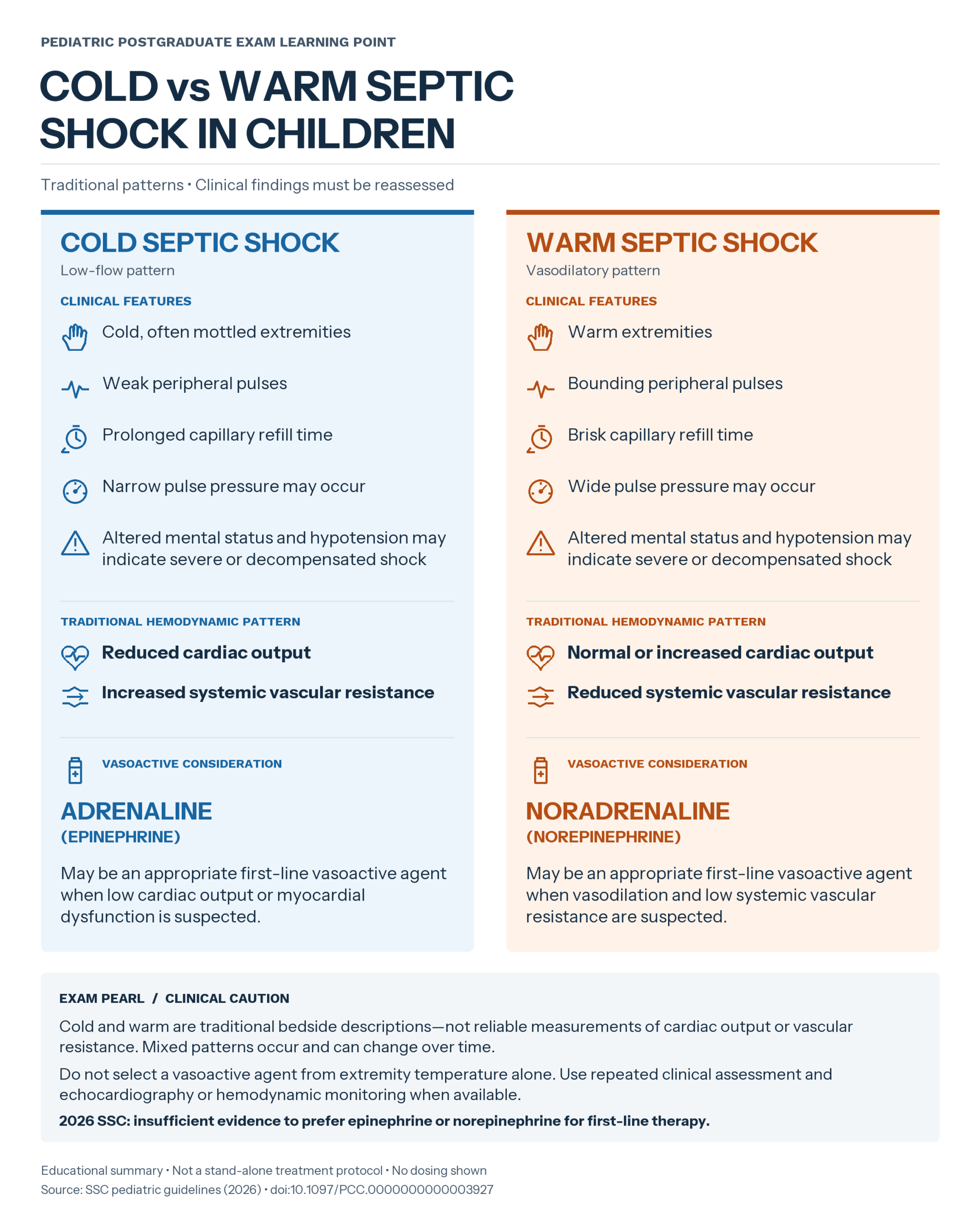
In the traditional hemodynamic classification, cold septic shock is associated with reduced cardiac output and increased systemic vascular resistance. However, clinical signs alone do not reliably establish the underlying hemodynamic pattern in every child.
Why Is Adrenaline the Correct Answer?
Adrenaline (epinephrine) is an appropriate first-line vasoactive agent for a child with cold septic shock and suspected low cardiac output or myocardial dysfunction. Its inotropic effects increase myocardial contractility and cardiac output, while its vascular effects can support blood pressure and tissue perfusion.
Management also requires prompt broad-spectrum antibiotics, carefully reassessed isotonic fluid boluses when indicated, and frequent evaluation of perfusion, blood pressure, urine output, lactate trends, and signs of fluid overload. If shock persists or fluid overload develops, vasoactive support should not be delayed while waiting for central venous access; administration through suitable peripheral or intraosseous access may be considered under an appropriate protocol.
The Surviving Sepsis Campaign pediatric guidelines recommend epinephrine or norepinephrine over dopamine as vasoactive options. They do not establish one agent as universally superior for every child; selection should be guided by the individual child’s physiology and response to treatment.
Read the Surviving Sepsis Campaign Pediatric Guidelines.
Why the Other Options Are Incorrect
A. Adrenaline (epinephrine)
Correct. It is a suitable first-line vasoactive agent when septic shock is accompanied by suspected low cardiac output or myocardial dysfunction. It supports myocardial contractility and systemic perfusion.
B. Dobutamine
Dobutamine is an inotropic agent that may be considered in selected children with documented or suspected myocardial dysfunction and persistent low cardiac output. It is not the default initial vasoactive choice for every child with cold septic shock, particularly when significant hypotension also requires support.
C. Dopamine
Dopamine is generally not preferred over epinephrine or norepinephrine for pediatric septic shock when either preferred agent is available. The pediatric Surviving Sepsis Campaign guideline suggests using epinephrine or norepinephrine rather than dopamine. Dopamine may remain an alternative when the preferred agents are unavailable.
D. Noradrenaline (norepinephrine)
Norepinephrine is particularly useful when vasodilation and low systemic vascular resistance predominate. However, it is not restricted exclusively to warm septic shock; it can also be an appropriate first-line agent in children depending on the hemodynamic profile and clinical response.
E. Vasopressin
Vasopressin may be considered as an additional agent in selected children with refractory shock requiring high-dose catecholamines. It is not the routine initial vasoactive agent for pediatric septic shock.
These are traditional patterns, not absolute rules. Use the full clinical picture and, when available, advanced hemodynamic assessment to guide therapy.
Examination pearl:
In a child with septic shock and suspected low cardiac output, adrenaline is a defensible first-line answer. In real clinical practice, vasoactive selection should be individualized rather than based solely on cold or warm extremities.
Find more high yield board exam MCQs on pediatric emergencies.
External Resources
Surviving Sepsis Campaign — Pediatric Guidelines (full text, PubMed Central)
Society of Critical Care Medicine — Surviving Sepsis Campaign Pediatric Guidelines
References (Vancouver Style)
Weiss SL, Peters MJ, Alhazzani W, Agus MSD, Flori HR, Inwald DP, et al. Surviving Sepsis Campaign international guidelines for the management of septic shock and sepsis-associated organ dysfunction in children. Pediatr Crit Care Med. 2020;21(2)–e106. doi: 10.1097/PCC.0000000000002198. Free full text.
Weiss SL, Peters MJ, Alhazzani W, Agus MSD, Flori HR, Inwald DP, et al. Executive summary: surviving sepsis campaign international guidelines for the management of septic shock and sepsis-associated organ dysfunction in children. Intensive Care Med. 2020;46(Suppl 1):1–9. doi: 10.1007/s00134-019-05877-7. PubMed record.