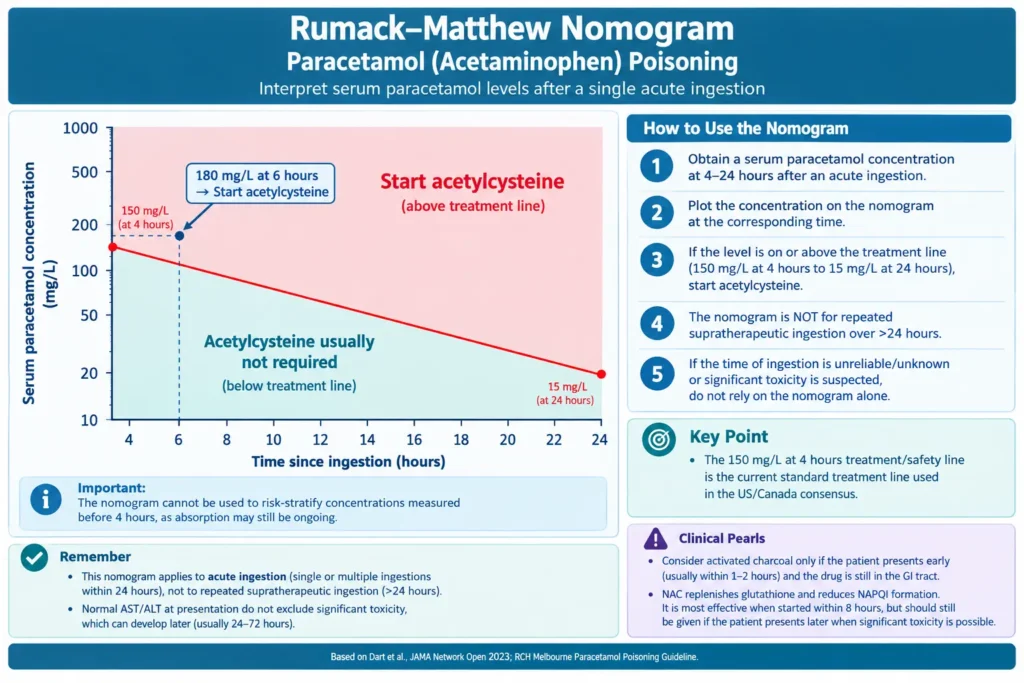
Clinical Scenario:
A 10-year-old boy is brought to the emergency department by his parents after they discovered that he had swallowed several paracetamol tablets approximately 6 hours earlier. He later admits that he took the tablets because he did not want to attend school the following day. He has mild nausea but is alert and haemodynamically stable. There is no abdominal tenderness or jaundice.
His serum paracetamol concentration at 6 hours is 180 mg/L. ALT and AST are normal.
What is the most appropriate next step?
A. Administer activated charcoal only
B. Begin N-acetylcysteine
C. Repeat paracetamol concentration after 12 hours
D. Reassure and discharge with follow-up
E. Wait for transaminases to become elevated
Correct answer & Explanation:
Correct answer: B. Begin N-acetylcysteine
Explanation Acetaminophen Poisoning
Paracetamol (acetaminophen) poisoning may initially be clinically silent or cause only mild nausea and vomiting. Hepatotoxicity generally develops later, so normal AST and ALT at presentation do not exclude significant poisoning.
In a known single acute ingestion, a serum paracetamol concentration obtained at least 4 hours after ingestion should be interpreted using the Rumack–Matthew nomogram. A serum paracetamol concentration of 180 mg/L at 6 hours lies above the treatment line on the Rumack–Matthew nomogram, indicating the need for acetylcysteine. NAC replenishes hepatic glutathione and reduces formation of the toxic metabolite NAPQI. It is most effective when started within 8 hours, but should still be given in patients presenting later when significant toxicity is possible.
Activated charcoal may have a role when the patient presents soon after a potentially toxic ingestion and the drug is still likely to be in the gastrointestinal tract, but at 6 hours it is not the best answer here.
Because the ingestion was intentional, the child also requires appropriate psychosocial assessment and safeguarding evaluation after medical stabilization. Pediatric poisoning guidance recommends taking deliberate self-poisoning seriously and assessing for intentional harm.
You can also practice another MCQ on poisoning.
References
Dart RC, Mullins ME, Matoushek T, et al. Management of acetaminophen poisoning in the US and Canada: a consensus statement. JAMA Netw Open. 2023;6(8):e2327739. doi:10.1001/jamanetworkopen.2023.27739.
- Royal Children’s Hospital Melbourne. Clinical Practice Guideline: Paracetamol Poisoning. Melbourne: Royal Children’s Hospital; updated guideline.
- Merck Manual Professional Edition. Acetaminophen Poisoning. Merck & Co.