
Clinical Pearls
Clinical Pearls: Neonatal Thrombocytopenia
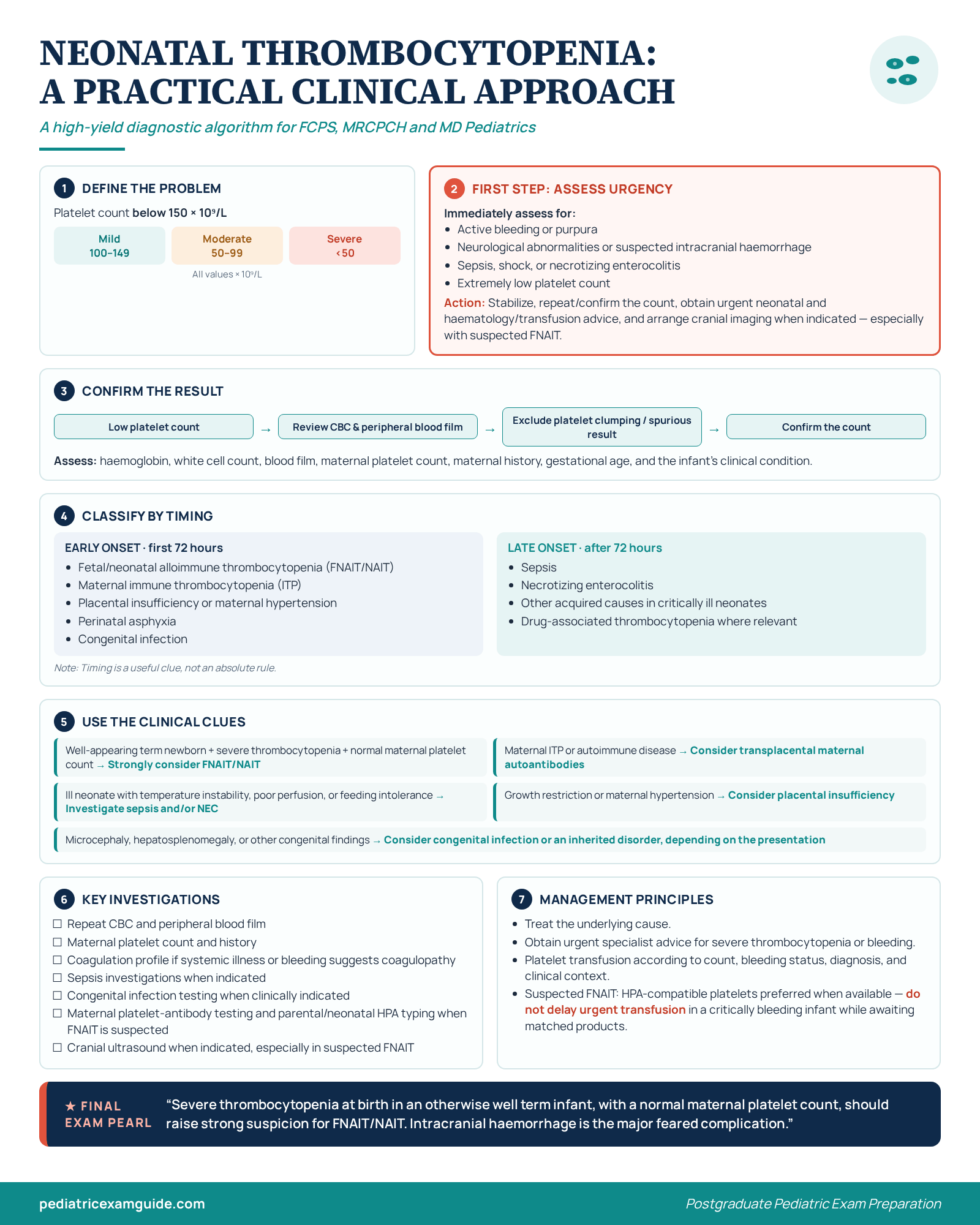
1. Timing helps identify the cause
Early-onset thrombocytopenia (within 72 hours): Consider placental insufficiency, maternal hypertension, perinatal asphyxia, congenital infection, and neonatal alloimmune thrombocytopenia (NAIT).
Late-onset thrombocytopenia (after 72 hours): Consider sepsis, necrotizing enterocolitis (NEC), and other acquired conditions, particularly in preterm or critically ill infants.
2. Maternal platelet count is a key discriminator
Severe neonatal thrombocytopenia with a normal maternal platelet count: Strongly suggests NAIT, particularly in an otherwise well term infant.
Maternal immune thrombocytopenia (ITP): Maternal autoantibodies cross the placenta and may cause neonatal thrombocytopenia.
Maternal platelet counts do not reliably predict the severity of neonatal thrombocytopenia in either condition.
3. Severity provides important diagnostic clues
Platelet count | Clinical interpretation |
|---|---|
100–149 × 10⁹/L | Mild thrombocytopenia |
50–99 × 10⁹/L | Moderate thrombocytopenia |
Below 50 × 10⁹/L | Severe thrombocytopenia; assess urgently |
Below 30 × 10⁹/L | Particularly concerning for bleeding, including intracranial haemorrhage |
These are commonly used severity categories; bleeding risk also depends on the underlying cause and the infant’s clinical condition.
4. NAIT versus neonatal thrombocytopenia due to maternal ITP
Feature | NAIT/FNAIT | Maternal ITP |
|---|---|---|
Maternal platelet count | Usually normal | Often low |
Mechanism | Maternal antibodies target fetal platelet antigens inherited from the father | Maternal autoantibodies target platelet antigens shared by mother and infant |
First pregnancy affected | Possible | Possible |
Severity in newborn | Can be profound | Variable, often less severe |
Intracranial haemorrhage | Important feared complication | Possible but less common |
5. A well-appearing newborn can still have a serious disorder
Severe thrombocytopenia in an otherwise healthy term infant should raise suspicion for NAIT, even without maternal thrombocytopenia or a family history. Intracranial bleeding can occur antenatally, so urgent specialist assessment and cranial imaging are important when NAIT is suspected.
6. Do not miss a falsely low platelet count
Platelet clumping in an EDTA sample can cause pseudothrombocytopenia. If the result does not fit the clinical picture, review the blood film and repeat the count using an appropriate alternative sample as advised by the laboratory.
7. Examine the whole infant, not just the platelet count
Look for:
Petechiae, purpura, mucosal bleeding, or bleeding from puncture sites
Signs of sepsis or NEC
Hepatosplenomegaly, microcephaly, or other features suggesting congenital infection
Signs of perinatal asphyxia or placental insufficiency
8. Management pearl
For suspected NAIT with severe thrombocytopenia or bleeding, arrange urgent neonatal and transfusion-medicine consultation. HPA-compatible platelets are preferred when available, but urgent platelet transfusion should not be delayed in a critically bleeding infant while waiting for matched products.
MCQ: Neonatal Thrombocytopenia
Neonatal Thrombocytopenia Approach
Resources for Further Reading
External Resources
Neonatal Thrombocytopenia: Etiology and Diagnosis – PubMed Central
A practical review of neonatal thrombocytopenia, including differential diagnosis, clinical assessment, blood film findings, and evaluation of an otherwise well-appearing newborn.How I Diagnose and Treat Neonatal Thrombocytopenia – PubMed
A contemporary review discussing diagnostic challenges, genetic causes, fetal and neonatal alloimmune thrombocytopenia, and platelet transfusion practice.Neonatal Alloimmune Thrombocytopenia: Pathogenesis, Diagnosis and Management – PubMed Central
A detailed review of FNAIT/NAIT, including maternal platelet antibodies, platelet antigen incompatibility, intracranial haemorrhage risk, and management.Neonatal Thrombocytopenia: Causes and Management – Archives of Disease in Childhood: Fetal and Neonatal Edition
Reviews the causes of neonatal thrombocytopenia and the clinical distinction between early-onset and late-onset presentations.Neonatal Thrombocytopenia – AAP NeoReviews
An educational review outlining a practical diagnostic strategy and common immune, inherited, and acquired causes.
References
Sillers L, Van Slambrouck C, Lapping-Carr G. Neonatal thrombocytopenia: etiology and diagnosis. Pediatr Ann. 2015;44(7)–e180. doi:10.3928/00904481-20150710-11.
How I diagnose and treat neonatal thrombocytopenia. Blood. 2023. Available from: https://pubmed.ncbi.nlm.nih.gov/36787503/
Peterson JA, McFarland JG, Curtis BR, Aster RH. Neonatal alloimmune thrombocytopenia: pathogenesis, diagnosis and management. Br J Haematol. 2013;161(1):3–14. doi:10.1111/bjh.12235.
Roberts I, Murray NA. Neonatal thrombocytopenia: causes and management. Arch Dis Child Fetal Neonatal Ed. 2003;88(5)–F364. doi:10.1136/fn.88.5.F359.
Fernández KS, de Alarcón PA. Neonatal thrombocytopenia. NeoReviews. 2013;14(2)–e82.