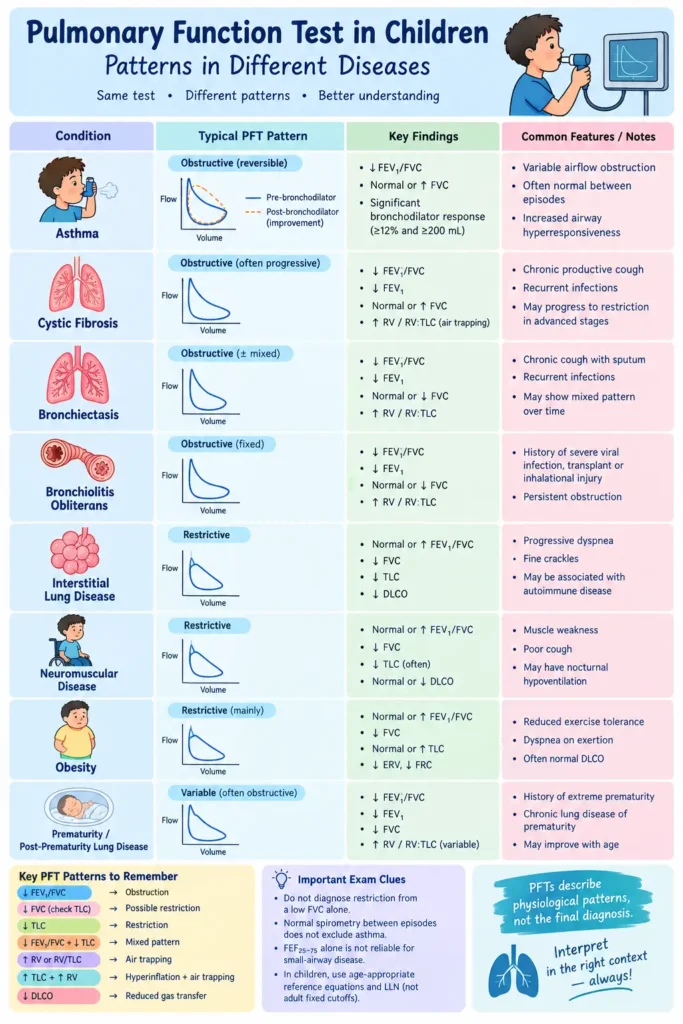
Exam Clues
- Low FEV₁/FVC below the LLN → Obstructive ventilatory pattern
- Low FVC → reduced forced vital capacity; restriction should be confirmed with TLC
- Low TLC → Restrictive ventilatory defect
- Low FEV₁/FVC + low TLC → Mixed obstructive and restrictive pattern
- Increased RV or RV/TLC → Air trapping
- Increased TLC + increased RV → Hyperinflation with air trapping
- Reduced DLCO → impaired gas transfer; consider parenchymal, pulmonary vascular, or other relevant causes after checking technical factors and hemoglobin
- Normal spirometry between episodes → does not exclude asthma
- FEF₂₅–₇₅ alone → should not be used to diagnose small-airway disease because of substantial variability
 Disease-Based Exam Clues on pulmonary function tests in children
| Exam clue | Think of |
|---|---|
| Variable airflow obstruction ± bronchodilator response | Asthma |
| Persistent obstruction + air trapping | Bronchiolitis obliterans |
| Obstruction ± air trapping/mixed physiology | Cystic fibrosis |
| Obstruction or mixed pattern with chronic suppurative airway disease | Bronchiectasis |
| Chronic airway disease with possible obstruction/air trapping | Primary ciliary dyskinesia |
| Low TLC ± reduced DLCO | Childhood interstitial lung disease |
| Low FVC/TLC with respiratory muscle weakness | Neuromuscular disease |
| Reduced ERV/FRC; TLC may be preserved or reduced | Obesity |
| Abnormal lung function after extreme prematurity | Post-prematurity respiratory disease |
 Age-Related Clues
- Preschool child unable to perform reliable forced spirometry → consider oscillometry or other tidal-breathing techniques.
- Preschool children can sometimes perform useful spirometry when appropriate techniques and quality criteria are applied.
- Oscillometry is particularly useful when conventional spirometry is difficult because it requires minimal cooperation.
- MBW/LCI assesses ventilation inhomogeneity and can detect abnormalities not always apparent on conventional spirometry.
 Most Important Exam Rule
Do not diagnose restriction from a low FVC alone.
Think:
Low FVC → check TLC → low TLC confirms restriction.
 Quick Pattern Recognition
FEV₁/FVC ↓ → Obstruction
TLC ↓ → Restriction
FEV₁/FVC ↓ + TLC ↓ → Mixed pattern
RV/RV ↑ → Air trapping
TLC ↑ + RV ↑ → Hyperinflation/air trapping
DLCO ↓ → Reduced gas transfer
 Pediatric Exam Pearl
In children, interpret spirometry using age-appropriate reference equations and the lower limit of normal (LLN) rather than applying the adult fixed FEV₁/FVC <0.70 cutoff.
Remember: PFTs describe physiological patterns; they do not by themselves establish the underlying diagnosis.