Clinical Scenario:
An 8-year-old girl presents with a 2-day history of lethargy, cough and progressive respiratory distress. Four days earlier, she had a mild febrile illness with sore throat, for which she received paracetamol only. She was previously well.
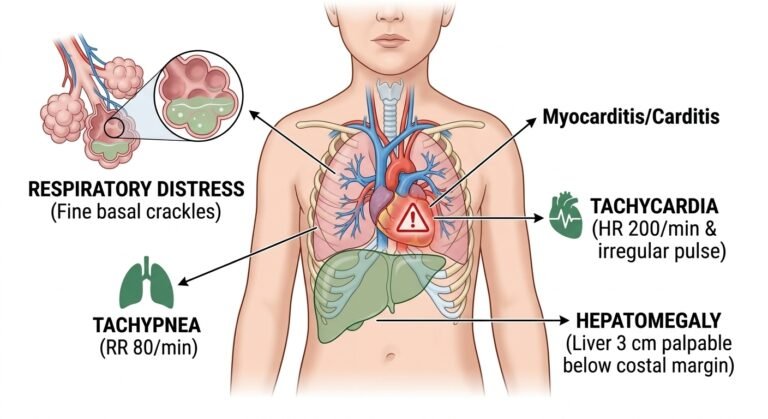
On examination, she is pale and markedly tachypnoeic with a respiratory rate of 80/min. Her heart rate is 200/min and irregular, with weak peripheral pulses and poor peripheral perfusion. The liver is palpable 3 cm below the right costal margin. There are fine basal crackles bilaterally.
What is the most likely diagnosis?
A. Acute myocarditis
B. Acute rheumatic carditis
C. Dilated cardiomyopathy
D. Supraventricular tachycardia
E. Viral pneumonia
Correct answer & Explanation:
Correct answer: A
Explanation
The most likely diagnosis is acute myocarditis presenting with acute decompensated heart failure and an associated arrhythmia.
The strongest clue is the sequence of a recent febrile/upper respiratory illness followed within a few days by acute cardiac deterioration. In children, myocarditis can present with acute congestive heart failure, respiratory distress, tachycardia, hepatomegaly, pulmonary crackles and, in severe cases, poor cardiac output and shock. Arrhythmias can also occur because of myocardial inflammation.
In this child:
- Tachypnoea (80/min) → severe respiratory distress, likely partly from pulmonary congestion.
- Heart rate 200/min with an irregular rhythm → suggests significant myocardial involvement with an arrhythmia rather than uncomplicated respiratory infection.
- Poor peripheral perfusion → indicates reduced cardiac output.
- Hepatomegaly → evidence of systemic venous congestion/right-sided heart failure.
- Basal crackles → pulmonary congestion from left-sided cardiac failure.
- Recent viral-like illness → supports an infectious/post-infectious trigger for myocarditis.
Nelson describes paediatric myocarditis as ranging from nonspecific illness to acute cardiogenic shock, with congestive heart failure, tachycardia and arrhythmias among the important manifestations.
Why not supraventricular tachycardia?
A rate of 200/min may initially suggest SVT, but SVT is typically a regular tachycardia. The deliberately stated irregular rhythm, together with evidence of myocardial dysfunction and heart failure, makes myocarditis with an associated arrhythmia more likely. ECG is essential to characterize the rhythm.
Why not acute rheumatic fever?
The sore throat is an intentional distractor. Acute rheumatic fever classically follows group A streptococcal pharyngitis after a longer latent period, rather than only four days later. Furthermore, this presentation is dominated by acute myocardial dysfunction, poor perfusion and arrhythmia rather than the typical clinical picture of acute rheumatic fever.
Why not viral pneumonia?
Pneumonia can cause fever, cough, tachypnoea and crackles, but it does not adequately explain the combination of marked tachycardia, irregular rhythm, hepatomegaly and poor peripheral perfusion. These findings point toward cardiac failure.
Why not dilated cardiomyopathy?
Dilated cardiomyopathy can produce a similar heart-failure phenotype, but the acute onset following a recent febrile illness favors acute myocarditis.
Reference:
Kliegman RM, St Geme JW, Blum NJ, et al. Nelson Textbook of Pediatrics. 22nd ed. Elsevier; 2025. Chapter 488: Diseases of the Myocardium.
[Nelson Textbook of Pediatrics, 22nd Edition – Elsevier]