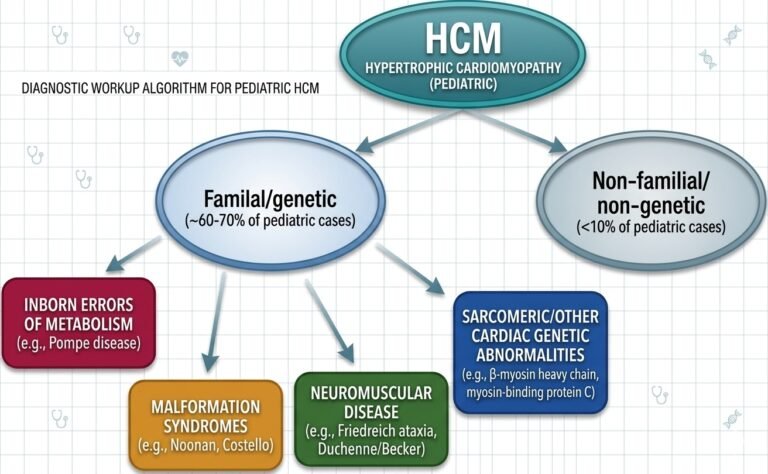
Clinical Scenario:
A 9-year-old boy is referred because of exertional chest pain and two episodes of near-syncope during exercise. His father died suddenly at 35 years of age. On examination, there is a harsh systolic murmur at the left sternal edge that becomes louder when he stands and softer when he squats.
ECG shows left ventricular hypertrophy with deep, narrow Q waves in the lateral leads. Echocardiography demonstrates marked asymmetric interventricular septal hypertrophy and systolic anterior motion of the mitral valve.
What is the most likely diagnosis?
A. Aortic stenosis
B. Dilated cardiomyopathy
C. Hypertrophic cardiomyopathy
D. Myocarditis
E. Pulmonary stenosis
Correct answer & Explanation:
Correct answer: C. Hypertrophic cardiomyopathy
Explanation
The most likely diagnosis is hypertrophic cardiomyopathy (HCM) with dynamic left ventricular outflow tract obstruction (LVOTO).
The combination of exertional chest pain, near-syncope, a family history of sudden cardiac death, asymmetric septal hypertrophy, and systolic anterior motion (SAM) of the mitral valve is highly characteristic of HCM.
The murmur provides an important clinical clue. It becomes louder on standing because reduced venous return decreases left ventricular cavity size and increases dynamic LV outflow obstruction. Squatting increases venous return and reduces the degree of obstruction, making the murmur softer. The AHA/ACC guideline specifically recommends provocative maneuvers such as standing or squat-to-stand to assess dynamic LVOTO.
Why the other options are wrong
A. Aortic stenosis
Aortic stenosis can cause exertional chest pain and syncope with a systolic ejection murmur, but it does not explain the marked asymmetric septal hypertrophy and systolic anterior motion of the mitral valve. The characteristic dynamic response of the murmur to standing and squatting also favors HCM.
B. Dilated cardiomyopathy
Dilated cardiomyopathy is characterized primarily by ventricular dilatation and systolic dysfunction, rather than asymmetric septal hypertrophy with dynamic LV outflow obstruction.
D. Myocarditis
Myocarditis can cause chest pain, arrhythmias and ventricular dysfunction, but the familial sudden cardiac death, marked septal hypertrophy and SAM strongly favor an inherited cardiomyopathy such as HCM.
E. Pulmonary stenosis
Pulmonary stenosis produces a systolic ejection murmur from obstruction of the right ventricular outflow tract. It would not explain the marked asymmetric left ventricular septal hypertrophy or SAM of the mitral valve.
Exam Pearl
Exertional syncope or near-syncope plus a family history of sudden cardiac death should raise strong suspicion for HCM. A systolic murmur that becomes louder with standing and softer with squatting is particularly suggestive of dynamic LV outflow tract obstruction.
If you are interested in more MCQs on Pediatric cardiology , Solve our MCQs on Cardiovascular system.
Reference
Ommen SR, Mital S, Burke MA, et al. 2024 AHA/ACC/AMSSM/HRS/PACES/SCMR Guideline for the Management of Hypertrophic Cardiomyopathy. Circulation. 2024