Precocious puberty = appearance of secondary sexual characteristics before 8 years in girls or 9 years in boys.
Central vs Peripheral
First Distinguish Central from Peripheral
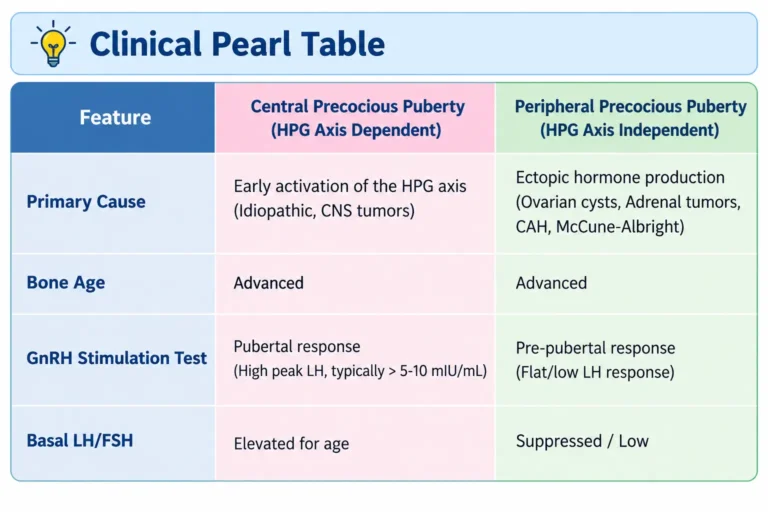
Central Precocious Puberty (CPP) — GnRH-dependent
- Premature activation of the hypothalamic–pituitary–gonadal (HPG) axis
- ↑ GnRH → ↑ LH/FSH → ↑ sex steroids
- Puberty generally progresses in the normal sequence, but too early
- Pubertal LH response to GnRH/GnRH-agonist stimulation
- Growth velocity and bone age are usually increased
Peripheral Precocious Puberty — GnRH-independent
- Sex steroids are produced without activation of the HPG axis
- LH/FSH remain prepubertal/suppressed
- Pubertal development may be discordant or atypical
- Causes include gonadal, adrenal, tumor-related, or exogenous sex-steroid production
Causes of Central Precocious Puberty
Causes of Central Precocious Puberty
Girls
- Idiopathic — most common
- CNS lesions/tumors
- Hypothalamic hamartoma
- Previous CNS irradiation, surgery, or trauma
- CNS infection/inflammation
- Rare genetic causes, e.g. MKRN3-related familial CPP
Boys
- CNS pathology is more likely than in girls
- Hypothalamic hamartoma
- CNS tumors/lesions
- Previous CNS irradiation, surgery, or trauma
- CNS infection/inflammation
- Idiopathic CPP can occur, but is less common than in girls
Causes of Peripheral Precocious Puberty
Causes of Peripheral Precocious Puberty
Estrogen excess
- Ovarian follicular cysts
- Granulosa-cell ovarian tumor
- McCune–Albright syndrome
- Exogenous estrogen
Androgen excess
- Congenital adrenal hyperplasia — especially 21-hydroxylase deficiency
- Adrenal tumor
- Testosterone-producing testicular (Leydig cell) tumor
- Familial male-limited precocious puberty (testotoxicosis)
- β-hCG–secreting tumors
- Exogenous androgen exposure
Exam Clues
Exam Clues
- Pubertal LH → Central
- Suppressed LH + high sex steroid → Peripheral
- Precocious puberty in a boy → strongly consider CNS pathology
- Café-au-lait spots + precocious puberty → McCune–Albright syndrome
- Virilization + high androgen → CAH/adrenal or gonadal source
- Testosterone high + LH suppressed in a boy → peripheral testosterone source
- Rapid growth + advanced bone age → significant sex-steroid exposure
- Breast development alone in a young girl, without growth acceleration or advanced bone age → consider premature thelarche rather than true precocious puberty
- Pubic hair/body odor alone → consider premature adrenarche
One-Line MCQ Approach
Early puberty → ask “Is the LH/HPG axis ON?” Pubertal LH = CENTRAL | Suppressed LH = PERIPHERAL → then identify the source.
📌 Update — 2026 Endocrine Society Guideline on Brain MRI in CPP
A new Endocrine Society clinical practice guideline, released June 2026, refines when brain MRI is indicated in confirmed CPP:
- Routine brain MRI is not recommended in girls aged 6.0–8.0 years or boys aged 8.0–9.0 years with confirmed CPP and no CNS symptoms or signs.
- Brain MRI remains important for:
- Any child with neurological symptoms/signs
- Girls with onset younger than 6 years
- Boys with onset younger than 8 years, given the higher baseline likelihood of CNS pathology in boys
- The guideline also favors ultrasensitive basal LH testing as a first-line diagnostic tool and supports a period of watchful observation (physical exams every 4–6 months) in select girls with early, slowly progressive breast development, rather than immediate full work-up.
Reference
Latronico AC, Roberts SA, Alonzo M, Argente J, Canton AP, Carel JC, et al. Central precocious puberty: an Endocrine Society clinical practice guideline. J Clin Endocrinol Metab. 2026;111(8):2101-2144. doi:10.1210/clinem/dgag168.
You can also practice MCQ on Precocious Puberty