Clinical Scenario:
A 12-year-old boy was diagnosed with acute rheumatic fever with carditis (mild mitral regurgitation) 3 years ago and has been on monthly intramuscular benzathine penicillin G since then, without any recurrence. He now presents to the pediatric cardiology clinic for a routine follow-up. Examination reveals a soft grade 2/6 apical pansystolic murmur, unchanged from previous visits. Echocardiography shows persistent mild mitral regurgitation with no progression, normal LV size and function, and no evidence of active carditis.
As per current guidelines, what is the most appropriate duration of secondary antibiotic prophylaxis for this child?
Options:
A. 5 years after the last episode or until age 18 years, whichever is longer
B. 10 years after the last episode or until age 21 years, whichever is longer, given carditis with residual valve disease
C. Lifelong prophylaxis, mandatory regardless of severity
D. Prophylaxis can be stopped now since there has been no recurrence for 3 years
E. Prophylaxis may be stopped once echocardiography shows no valve involvement
Correct answer & Explanation:
Key: B
Explanation:
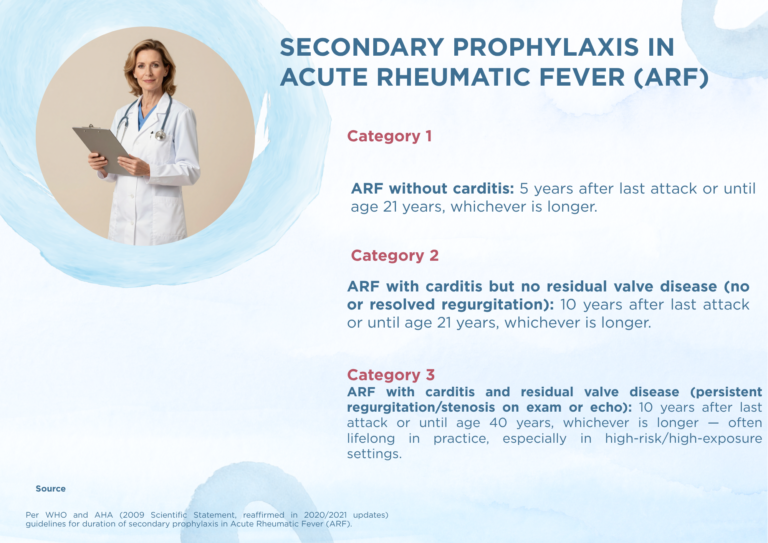
Secondary antibiotic prophylaxis duration in acute rheumatic fever/rheumatic heart disease is determined by whether carditis occurred and whether residual valve disease persists — not simply by time elapsed since the last episode or clinical stability.
This boy has carditis at initial diagnosis with persistent mitral regurgitation on echo (i.e., residual valvular disease). Therefore, he falls into the highest-risk category, warranting the longest duration of prophylaxis — extending well beyond simple time-based cutoffs, essentially into adulthood/lifelong, particularly given ongoing streptococcal exposure risk.
Why B best fits among the options:
Option B correctly identifies that his carditis with residual valve disease mandates prolonged prophylaxis (10 years or until age 21, whichever is longer — with many guidelines extending this further based on risk of re-exposure), making it the most accurate answer among the choices given.
Why other options are wrong:
- A — This duration applies to ARF without carditis, not this patient’s case.
- C — Overstates the rule; “lifelong regardless of severity” is not the standard recommendation for all patients — it depends on risk stratification (persistent valve disease, exposure risk, occupation e.g., teachers/healthcare workers/military recruits).
- D — Incorrect and dangerous; stopping prophylaxis based on absence of recurrence alone ignores the persistent valve pathology, which carries ongoing risk of ARF recurrence and further valve damage.
- E — Incorrect; this patient’s echo does show residual valve involvement, so this reasoning doesn’t even apply here, and echo normalization alone isn’t sufficient justification for stopping in guidelines.
Guidelines referenced:
- Gerber MA, et al. Prevention of Rheumatic Fever and Diagnosis and Treatment of Acute Streptococcal Pharyngitis: A Scientific Statement From the AHA. Circulation. 2009;119:1541–1551.
- WHO Technical Report Series 923: Rheumatic Fever and Rheumatic Heart Disease. WHO, 2004.
- RHD Australia (ARF/RHD Guideline, 3rd edition, 2020) — widely used for standardized risk-based prophylaxis duration.
Practice another similar high -Yield MCQ.