Clinical Scenario:
A 2-year-old boy is brought to the emergency department with sudden drooling, refusal to eat, and repeated vomiting for the past 2 hours. His parents did not witness any ingestion but report that a remote control battery is missing. He is alert, has mild stridor, and is maintaining oxygen saturation.
A chest radiograph shows a round radiopaque foreign body with a double-rim (halo) sign at the level of the upper thoracic esophagus.
What is the most appropriate next step in management?
A. Observe for spontaneous passage
B. Give a carbonated drink
C. Endoscopic removal immediately
D. Repeat radiograph after 12 hours
E. Start proton pump inhibitor therapy
Correct Answer & Explanation:
The correct answer is C. Endoscopic removal immediately.
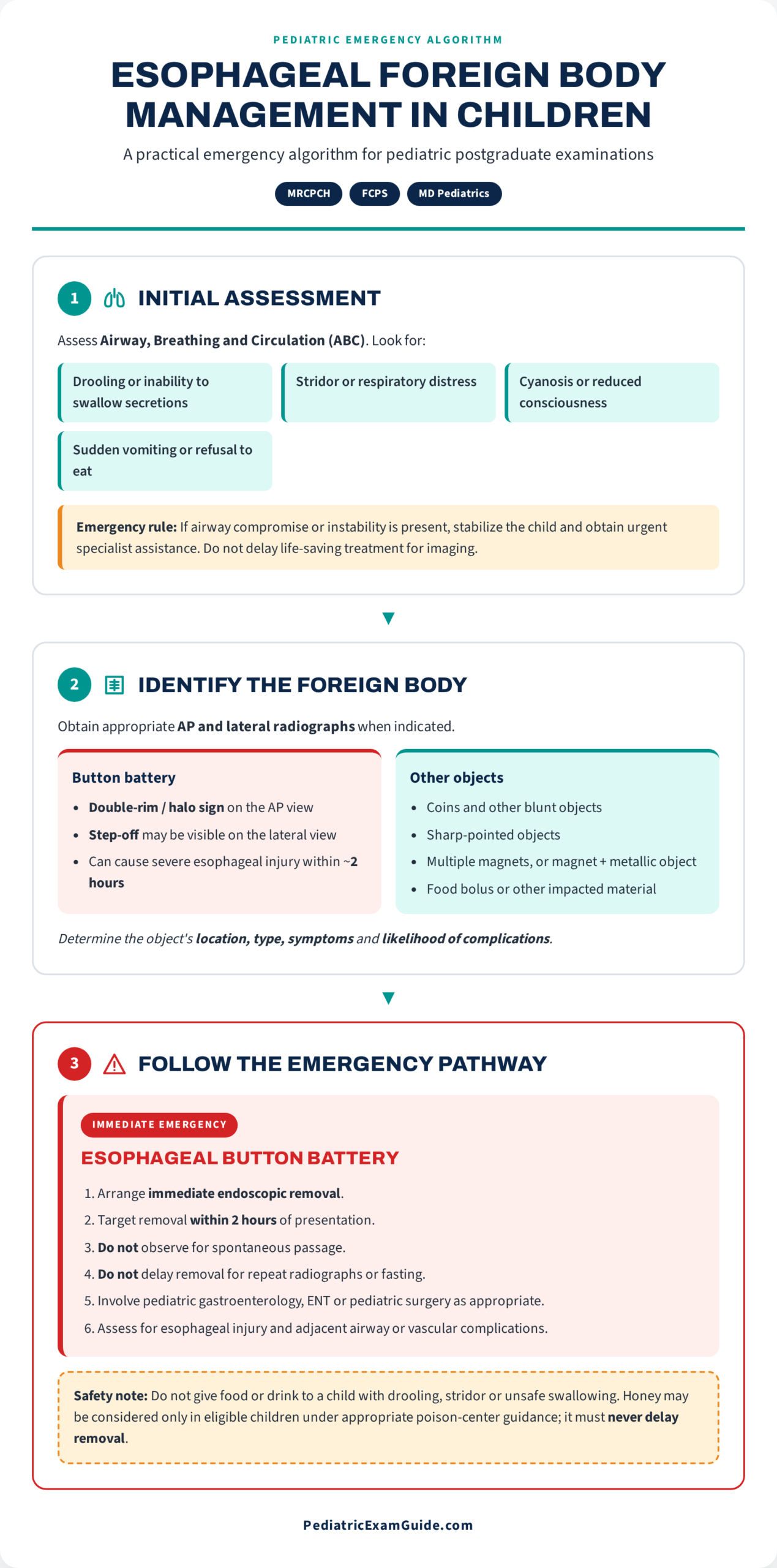
This is a suspected esophageal foreign body impaction, a time-critical pediatric emergency. The combination of sudden drooling, refusal to eat, vomiting, mild stridor, a missing remote-control battery, and the radiographic double-rim (halo) sign strongly indicates a button battery lodged in the esophagus.
A child may initially maintain normal oxygen saturation despite significant esophageal injury. Do not observe or delay removal to repeat imaging.
Explanation: Esophageal foreign body
Why is immediate removal required?
Button batteries can cause severe esophageal injury through electrochemical generation of hydroxide ions at the negative pole, producing a highly alkaline environment that damages tissue. Pressure and leakage may also contribute to injury.
Double-rim (halo) sign: The characteristic appearance of a button battery on an anteroposterior radiograph. A step-off on the lateral view can provide additional confirmation.
Drooling and refusal to eat: Suggest esophageal obstruction or painful swallowing.
Vomiting and stridor: Indicate clinically significant symptoms and possible involvement or compression near the airway.
Short duration of symptoms: Does not make observation safe. Serious tissue damage can develop within approximately two hours.
Management of esophageal foreign body: Keep the child nil by mouth, urgently involve pediatric gastroenterology/endoscopy and ENT or pediatric surgery as appropriate, and arrange emergency removal under controlled conditions with appropriate airway support. Current guidance recommends immediate removal of an esophageal button battery, ideally within two hours of presentation. Do not delay removal for fasting or repeat radiographs.
Why are the other options incorrect?
Option | Explanation |
|---|---|
A. Observe for spontaneous passage | Unsafe for a battery lodged in the esophagus because progressive caustic injury can occur rapidly. |
B. Give a carbonated drink | Does not treat battery impaction and may increase aspiration risk in a child with drooling and stridor. |
C. Endoscopic removal immediately | Correct. Emergency removal limits ongoing tissue injury. |
D. Repeat radiograph after 12 hours | An unacceptable delay when the battery is already confirmed in the esophagus. |
E. Start proton pump inhibitor therapy | Does not neutralize the battery’s electrochemical injury or remove the obstruction. |
Important clinical pearl
Honey or sucralfate may be considered as a temporary injury-mitigation measure in selected children while awaiting esophageal foreign body removal, under appropriate guidance. Honey is generally considered only for children aged at least 12 months who can swallow safely and when ingestion occurred within the preceding 12 hours. Neither treatment replaces or delays emergency removal. In this child, drooling and stridor make oral administration particularly inappropriate without specialist assessment.
Delayed complications can include esophageal perforation, tracheoesophageal fistula, strictures and, rarely, life-threatening vascular fistula or hemorrhage. Endoscopic assessment and follow-up depend on the extent and location of the injury.
Find another clinical scenario based high-yield Board MCQ on Hypernatremic dehydration.
External Resources
National Capital Poison Center – Button Battery Ingestion Triage and Treatment Guideline
Practical guidance on the emergency management of esophageal button battery ingestion.ESPGHAN Position Paper – Diagnosis, Management, and Prevention of Button Battery Ingestion in Childhood
Pediatric specialist guidance on diagnosis, urgent removal, complications, and follow-up.NASPGHAN Clinical Report – Management of Ingested Foreign Bodies in Children
Guidance on the evaluation and management of foreign bodies in children.
References
Mubarak A, et al. Diagnosis, management, and prevention of button battery ingestion in childhood: an ESPGHAN position paper. J Pediatr Gastroenterol Nutr. 2021;73(1):129–136. PubMed.
Kramer RE, et al. Management of ingested foreign bodies in children: a clinical report of the NASPGHAN Endoscopy Committee. J Pediatr Gastroenterol Nutr. 2015;60(4):562–574.
National Capital Poison Center. Button battery ingestion triage and treatment guideline.